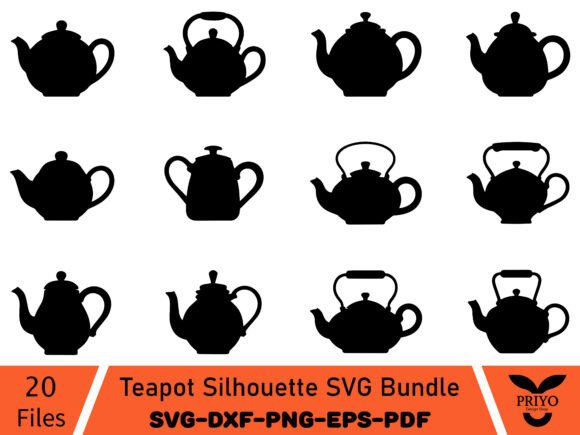
Teapot Silhouette SVG Bundle
A Quiet Charm That Stitches Well—If You Choose the Right Moment
I pulled up the Teapot Silhouette SVG Bundle last week while prepping a custom order: a set of linen tea towels for a local café’s holiday gift bundle. The client wanted something warm but uncluttered—no florals, no script, just clean, recognizable charm. That’s when this design caught my eye—not with flash, but with quiet confidence. It’s a single-line silhouette, minimal in detail but rich in suggestion: a classic spouted teapot, slightly tilted, with gentle curves and balanced negative space. It doesn’t shout “tea party.” It whispers “slow morning,” and that subtlety is exactly what makes it work—or sometimes, not work—in real embroidery.
Where This Design Naturally Lives (and Thrives)
The Teapot Silhouette SVG Bundle shines brightest on stable, medium-weight fabrics where clarity matters more than complexity. Think embroidered tote bags made from canvas or duck cloth—clean stitching reads well at 3–4 inches wide. It holds up beautifully on cotton sweatshirts, especially when digitized with thoughtful stitch direction and moderate fill density. I tested it on a navy crewneck using a light gray thread: the shape remained crisp, no bleeding, no puckering. It also translated cleanly to an embroidered patch—ideal for aprons, baby onesies, or kitchen-themed nursery decor. As an applique design, it’s forgiving: the outline gives structure, and the open interior means less dense fill stitch, which reduces bulk on delicate items like toddler bibs or linen pillow covers.
For Etsy sellers and small shop owners, this is solid digital embroidery file territory. It’s versatile enough to appear across multiple product types—tote bag design, sweatshirt embroidery, holiday embroidery for mugs or tea towels—without needing heavy reworking. And because it’s rooted in illustration rather than typography or realism, it avoids seasonal or trend fatigue. You won’t need to retire it after one spring collection.
Where to Pause—and Why
This isn’t a one-size-fits-all machine embroidery design. Its simplicity becomes a liability on tricky surfaces. On curved caps or structured hats, the silhouette’s smooth contour can distort if hooping isn’t precise or stabilizer isn’t layered correctly. On thin or stretchy fabric—like lightweight jersey tees—the lack of internal detail means any slight shifting during stitching shows more readily than with busier motifs. And on dark fabric? Always test thread colors first. A pale ecru satin stitch may vanish; a charcoal running stitch might read better as a subtle outline.
It’s also not ideal for tiny hoop sizes under 3 inches unless simplified further. The spout and handle rely on fine proportions—if shrunk too far, they risk becoming indistinct or fragile in stitch. Likewise, avoid pairing it with dense decorative accents nearby—this design earns its value through breathing room, not embellishment.
What Your Customers Will Actually Notice
People don’t see “SVG” or “illustration.” They see how your finished product feels. When stitched cleanly onto a flour-sack tea towel, the Teapot Silhouette SVG Bundle reads as intentional, handmade, and quietly sophisticated. It signals care—not just in execution, but in curation. That builds trust. A customer buying a personalized gift isn’t just paying for thread and fabric; they’re investing in tone and intention. This design delivers that without overpromising.
Conversely, if stitched poorly—on low-quality stabilizer, with mismatched thread tension, or on a fabric that pills easily—it looks generic. Not amateurish, exactly—but forgettable. That’s the tightrope: its strength is its restraint, and restraint only works when supported by craft discipline.
Practical Notes Every Embroidery Designer Should Run Through
- Test first on scrap fabric—especially if using textured weaves like burlap or terry cloth. The silhouette’s clean edge can snag or float unpredictably.
- Review stitch density before sending to your machine. Low-density fill works best here—this isn’t a design that needs weight.
- Confirm hoop size compatibility. While scalable, the original proportions assume a 4x4 or larger hoop for optimal clarity.
- Inspect small details at actual stitch-out size: does the spout hold definition? Does the handle read as connected, not floating?
- Try black-and-white mockups before finalizing. This design relies on contrast, not color.
- Compare light and dark backgrounds. What reads softly on ivory may disappear on charcoal—adjust thread accordingly.
- Use proper stabilizer: tear-away for stable wovens, cut-away for knits, and always match weight to fabric.
- Check licensing. Since the listing mentions “commercial use” only implicitly (“ideal for prints, t-shirt designs…”), verify whether the Teapot Silhouette SVG Bundle permits resale of finished embroidered products or digital embroidery files—especially if you’re an Etsy seller or digital product creator.
Final Thought: A Design That Serves, Not Demands
This isn’t a showstopper design. It won’t dominate a tradeshow booth or go viral on Instagram. But for craft business owners building a cohesive line—kitchen goods, nursery sets, boutique apparel, personalized gifts—it’s a reliable, repeatable asset. It fits naturally within collections of Illustrations and Graphics that prioritize harmony over hype. Used thoughtfully, the Teapot Silhouette SVG Bundle adds warmth without clutter, distinction without drama, and professionalism without pretense. That’s rare. And honestly? That’s why I’ll keep it in my active folder—not as a novelty, but as a quiet, steady tool.