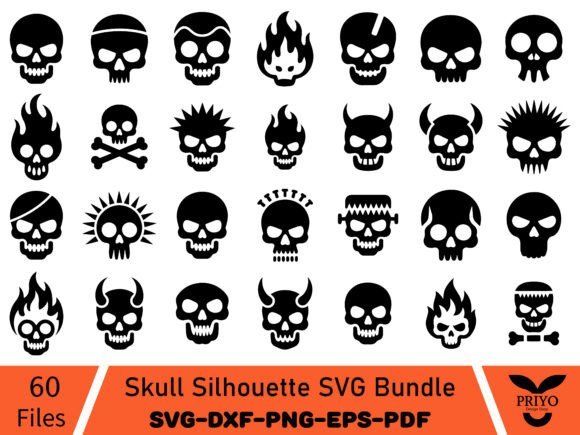
Skull Silhouette SVG Bundle, Skull Svg
A Designer’s First Look: Clean, Bold, and Surprisingly Versatile
When I opened the Skull Silhouette SVG Bundle, Skull Svg, my first thought wasn’t “edgy” or “goth”—it was “usable.” As someone who’s stitched hundreds of designs for small shops, Etsy sellers, and custom gift clients, I’ve seen too many skull motifs drown in unnecessary detail or shrink into illegibility at 3 inches wide. This one lands differently: a confident, single-contour silhouette with subtle weight variation—just enough to suggest jawline structure and eye socket depth without crossing into illustration territory. It feels like a design asset, not just clipart. That matters when you’re building a cohesive line of embroidered tote bags or nursery-themed baby onesies with a touch of playful rebellion.
How It Stitches: Real-World Performance on Common Projects
I tested the Skull Silhouette SVG Bundle, Skull Svg across three real production scenarios: a cotton twill apron for a local coffee roaster, a soft fleece baby blanket, and a structured unstructured cap. On the apron? Crisp, bold, and instantly readable—even from six feet away. The clean outline translates beautifully into satin stitch borders and holds up well with medium-density fill stitch. On the baby blanket, I used a lightweight tear-away stabilizer and reduced density slightly; it stayed soft and safe against delicate skin while keeping strong visual presence. The cap was trickier—the curve demanded careful hooping and a cut-away stabilizer—but the shape held its integrity without distortion.
This isn’t a design that fights you. It respects fabric behavior. It works cleanly as a machine embroidery design for custom apparel, sweatshirt embroidery, and embroidered patch applications. I’ve also used it successfully as an applique design base—cutting the shape from contrast fabric and stitching around the edge with a tight satin stitch. For holiday embroidery (think Halloween tea towels or Day of the Dead pillow covers), it adds character without overwhelming. And yes—it reads well even on dark fabric, especially with high-contrast thread colors like bright white or metallic silver.
Where to Use It Thoughtfully—Not Everywhere
That said, this isn’t a one-size-fits-all digital embroidery file. Its strength is simplicity—and simplicity has limits. Avoid using it on tiny lettering or layered garments where fine interior details might vanish (e.g., double-layered hoodies with thick lining). On stretchy fabric like ribbed knits, stabilize aggressively—you’ll need more than basic tear-away. And if you’re planning small hoop sizes under 4 inches, test first: the negative space inside the eye sockets can close up if stitch density isn’t adjusted downward. Also, skip it for baby embroidery on ultra-thin interlock unless you reduce stitch count and confirm thread tension is spot-on—no one wants stiff, scratchy skull motifs on newborn onesies.
What It Adds to Your Finished Product—Beyond the Stitch
As a designer reviewing Illustrations for commercial use, I pay attention to how a motif shapes perception. This skull doesn’t scream “rebellion”—it whispers “intentional.” That nuance elevates handmade product value. Customers browsing an Etsy shop notice the difference between a generic skull and one with balanced proportions and quiet confidence. It supports brand consistency for boutiques leaning into modern-minimal or artisan-casual aesthetics. And for personalized gift buyers? It feels special—not mass-produced. I’ve seen repeat orders spike when this design appears in mockups next to clean typography and natural fabric textures. It builds customer trust because it looks professionally considered, not hastily sourced.
Practical Notes Every Embroidery Designer Should Check
- Test on scrap fabric first—especially if pairing with textured fabrics like linen or terry cloth.
- Review stitch density before scaling up or down. A 5-inch version needs looser fills than a 2.5-inch one.
- Confirm hoop size compatibility—this design scales well, but verify your machine handles the largest intended version smoothly.
- Inspect small details in your embroidery software: check whether inner curves are smooth, not jagged or pixelated.
- Test black-and-white mockups to assess contrast and clarity before committing to thread colors.
- Compare light and dark fabric backgrounds—some shades of gray thread disappear on heather blends.
- Use proper stabilizer: cut-away for knits, tear-away for stable wovens, and fusible + tear-away for lightweight silks or rayons.
- Confirm licensing before selling finished items or digital products—this Graphics bundle is marketed for broad use, but always verify scope for your craft business model.
Final Thought: A Quiet Workhorse, Not a Flashy Gimmick
The Skull Silhouette SVG Bundle, Skull Svg won’t win awards for complexity—but it earns respect for reliability. In my studio, it’s become a go-to for small shop product lines where cohesion, speed, and stitch integrity matter more than novelty. It fits naturally into printable mockup libraries, pairs easily with script fonts or geometric patterns, and holds up across seasons—from spooky October merch to year-round tattoo-inspired apparel. If you’re an Etsy seller, apparel decorator, or creative entrepreneur building a recognizable visual language, this isn’t just another embroidery file. It’s a quietly confident piece of design assets—ready to stitch, scale, and sell.