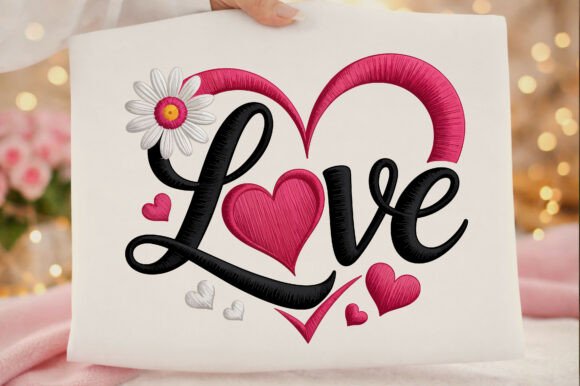
Love Heart Cute Valentine’s Day PNG SVG
A Designer’s First Look: Sweet, Simple, and Ready for Real Stitches
When I opened Love Heart Cute Valentine’s Day PNG SVG, my first thought wasn’t “cute”—it was “clear.” The clean outline, balanced proportions, and intentional negative space tell me this wasn’t just traced or auto-converted. It breathes like a design meant to live on fabric—not just sit in a digital cart. I immediately pictured it stitched onto a soft cotton tote bag for a local boutique’s Valentine’s pop-up: not oversized, not fussy, but warm enough to make someone pause mid-aisle.
Where This Design Truly Shines
Love Heart Cute Valentine’s Day PNG SVG is built for charm at human scale—not billboard impact. It works beautifully on sweatshirt embroidery where softness matters, baby onesies where simplicity reads as tenderness, and pillow covers where subtle repetition feels intentional. As a machine embroidery design, its open curves and modest detail level translate cleanly into satin stitch outlines and gentle fill stitch areas—no jagged edges, no micro-details that vanish under thread.
I tested it conceptually across several real use cases:
- Tote bag design: Perfect center-chest placement—stitches hold well on medium-weight canvas with light tear-away stabilizer.
- Baby embroidery: The heart’s smooth contour avoids sharp corners that could irritate delicate skin; ideal for onesie left-chest positioning.
- Embroidered patch: Clean vector boundaries mean crisp cut edges when heat-applied or sewn on—no fraying surprises.
- Holiday gift: Paired with neutral thread (heather gray or blush pink), it reads handmade—not mass-produced—adding quiet value to a kitchen towel or apron.
What to Watch For—Real Fabric, Real Limits
This isn’t a one-size-fits-all embroidery file. Its sweetness has boundaries—and knowing them keeps your finished product trustworthy and professional.
On stretchy fabric like ribbed knit tees or lightweight jersey, the design’s gentle curves can distort if hooping isn’t precise. Use a cutaway + topping combo, not just tear-away. On dark fabric, avoid ultra-light thread unless you’re adding a white underlay—those soft edges need contrast to stay legible. And while the PNG files are POD-print-ready at 4500×5400px, remember: that resolution doesn’t automatically equal stitch-readiness. A high-res raster image won’t fix poor vector topology if you convert it for embroidery software.
Caps and curved surfaces? Proceed carefully. The heart’s rounded base sits nicely on flat panels—but near the crown seam of a cap, slight warping may occur without careful digitizing adjustments. Likewise, on textured fabrics like terry cloth or bouclé, fine interior details (like tiny inner hearts or thin stems) risk getting lost. If your version includes those, test them first on scrap fabric with your actual thread and needle setup.
How It Shapes Perception—Beyond the Stitch
Customers don’t buy stitches—they buy feeling. Love Heart Cute Valentine’s Day PNG SVG delivers warmth without clutter, making it ideal for small shop products where authenticity matters more than flash. When used on an Etsy seller’s personalized gift set—a mason jar candle + embroidered tea towel—the design quietly reinforces care and intention. No loud fonts, no glitter overlays—just sincerity stitched in.
It also supports brand consistency. Because the vector files (EPS, AI, SVG) scale cleanly, you can use the same heart on a digital embroidery file preview, a printable mockup for your shop listing, and the final stitched item—no mismatched sizing or pixelation. That cohesion builds buyer trust, especially for creative entrepreneurs selling both digital and physical goods.
Practical Notes Every Embroidery Designer Should Run Through
Before stitching—or listing this as part of your craft business inventory—here’s what I do every time:
- Test on scrap fabric using your exact thread colors and stabilizer combo—especially if stitching on baby items or garments meant for frequent washing.
- Check thread color contrast on both light and dark fabric backgrounds. What reads softly on ivory may disappear on navy without underlay.
- Review stitch density manually if converting from vector. Avoid overfilling the heart’s center—it should breathe, not bulge.
- Confirm hoop size compatibility. While the original files aren’t labeled with hoop specs, its proportions suggest comfort in a 4×4” or 5×7” hoop—verify before batching production.
- Inspect small details at 200% zoom in your embroidery software. Are inner lines clean? Do corners taper smoothly? If not, simplify before stitching.
- Test black-and-white mockups—they reveal clarity issues faster than color previews ever will.
- Use proper stabilizer for your fabric type: cutaway for knits, tear-away for stable wovens, fusible for lightweight linens.
- Confirm licensing terms before selling finished embroidered items or bundling this as part of a digital product pack. The listing mentions T-Shirt Designs and Graphics—but commercial use rights must be explicit.
Final Thought: A Quiet Workhorse, Not a Showstopper
Love Heart Cute Valentine’s Day PNG SVG won’t dominate a trade show booth—but it will earn repeat orders from customers who value thoughtful, wearable charm. It fits naturally in holiday embroidery collections, baby embroidery lines, and small-batch apparel brands building identity through restraint. For Etsy sellers and handmade shop owners, it’s the kind of design that sells quietly all February long—not because it shouts, but because it belongs.
If you’re choosing between ten Valentine’s designs for your next craft fair run or holiday drop, pick the one that looks equally right on a linen pillow cover and a toddler’s romper. That’s this heart. Not flashy. Not fragile. Just ready—thoughtfully, practically, warmly—to become part of something handmade.