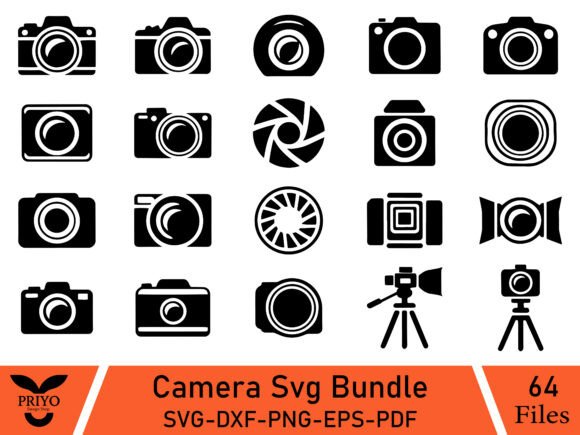
Camera SVG Bundle
A Designer’s First Look: Clean, Nostalgic, and Surprisingly Versatile
When I opened the Camera SVG Bundle for the first time—prepping it for a custom embroidered tote bag order—I paused. Not because it was overly complex, but because it struck that rare balance: simple enough to stitch cleanly on mid-weight canvas, yet expressive enough to carry personality. It’s not a photorealistic DSLR or a cluttered retro collage. It’s a stylized, friendly camera icon—rounded edges, subtle lens detail, clean silhouette—with just enough visual weight to read clearly at 3–4 inches wide. As an embroidery designer who’s seen hundreds of “camera” motifs, this one feels intentional—not generic, not gimmicky, and quietly confident in its minimalism.
Where It Shines: Real Projects, Real Clients
I used the Camera SVG Bundle on a natural linen tote for a local photography studio’s client gift set. Paired with soft grey thread and a light tear-away stabilizer, it stitched out crisply—no puckering, no skipped stitches. That tells me it’s well-structured for machine embroidery design work: balanced fill stitch distribution, no ultra-thin connecting lines prone to breaking, and generous spacing between elements (critical when converting to embroidery files). It translated beautifully to sweatshirt embroidery too—on a heather charcoal crewneck, the shape held up even with slight fabric stretch and loft.
It’s also worked well as a baby embroidery motif on a cotton onesie—scaled down to 2.25", it retained legibility without needing heavy underlay. For boutique branding, I’ve layered it subtly into corner embroidery on tea towels and pillow covers, where its clean graphic nature supports rather than overwhelms hand-stitched texture. And yes—it’s been a quiet hit as a personalized gift: newlyweds getting matching aprons with their initials + the Camera SVG Bundle icon beside “First Home, First Shots.” Customers notice it. They comment on how “thoughtful” and “not-too-cute” it feels.
Where to Proceed Thoughtfully
This isn’t a one-size-fits-all embroidery file—and that’s a good thing. Its charm lies in restraint, so pushing it too far risks losing clarity. Avoid using the Camera SVG Bundle at under 1.75" on structured caps or curved surfaces like baseball hats unless you’ve tested the stitch density thoroughly. On thin or highly textured fabrics—think lightweight rayon challis or bouclé knits—the outline can blur if stabilizer choice is off. Dark fabric demands attention: test thread colors early. A warm cream works better than stark white on navy; charcoal thread reads richer than black on black.
Also note: while it’s labeled as a Graphics asset and fits neatly into Illustrations categories, it wasn’t built for dense applique design layers or multi-step satin stitch borders. If your project relies on high-contrast decorative accents—like metallic thread outlines or puff embroidery—you’ll need to adapt manually. And for holiday embroidery or wedding gifts where sentimentality runs high, consider pairing it with a short phrase (“Click. Love. Repeat.”) rather than relying on the icon alone to carry emotional weight.
What It Adds—Beyond the Stitch
The Camera SVG Bundle elevates handmade product perception without shouting. On Etsy listings, it helps craft business owners stand out in saturated niches—photography-themed shops, teacher appreciation bundles, or creative entrepreneur merch—because it looks designed, not downloaded. Buyers recognize that polish. It builds customer trust: when a custom apparel piece arrives with crisp, proportional embroidery, it signals care—not just speed. That directly affects giftability and repeat orders.
For small shop product development, it’s flexible enough to anchor a cohesive line: same icon across embroidered patches, printable mockups for social previews, digital embroidery file bundles, and even simplified versions for iron-on transfers. But—and this matters—it doesn’t dominate brand consistency. It complements; it doesn’t compete. Use it as a secondary mark alongside your logo, and it reinforces creativity without diluting voice.
Practical Embroidery Designer Notes
- Always test first: Run the Camera SVG Bundle on scrap fabric matching your final substrate—especially for stretchy or dark fabrics.
- Check contrast early: Preview in black and white mockups. Does the shape hold? Does negative space read?
- Review stitch density: If your machine flags high-density areas, reduce fill stitch % slightly—this design responds well to minor tweaks.
- Confirm hoop size: At standard 3.5" width, it fits most 4x4 hoops comfortably—but verify before hooping delicate items like baby blankets.
- Inspect fine details: Zoom in on lens circles and strap curves. Are corners rounded enough for smooth satin stitch flow?
- Stabilizer matters: Light cutaway for knits, tear-away for stable wovens, and ultra-light mesh for sheer fabrics.
- Licensing check: Since the listing notes it’s ideal for “many tasks, whether…”—confirm commercial use rights before selling finished products or bundling as digital embroidery file assets.
Final Thought: A Quiet Workhorse, Not a Flashy Gimmick
The Camera SVG Bundle won’t wow with complexity—but then, it’s not meant to. It’s the kind of design that earns repeat use because it simply *works*: in the hoop, on the garment, and in the customer’s hands. It suits the photographer who wants understated gear-themed merch, the Etsy seller building a cohesive nursery decor line, the craft fair vendor stitching personalized gifts for teachers and new parents—and yes, even the small shop owner refreshing their boutique branding with tactile, embroidered authenticity. It’s proof that thoughtful simplicity, well-executed, remains one of the strongest tools in any embroidery project toolkit.