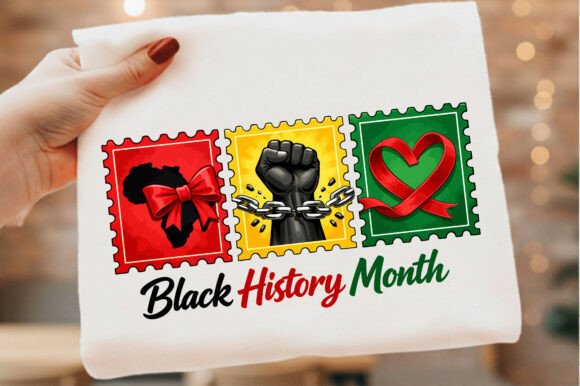
Black History Month PNG SVG EPS T-Shirt
A Designer’s First Look: Clean, Respectful, Ready for Stitching
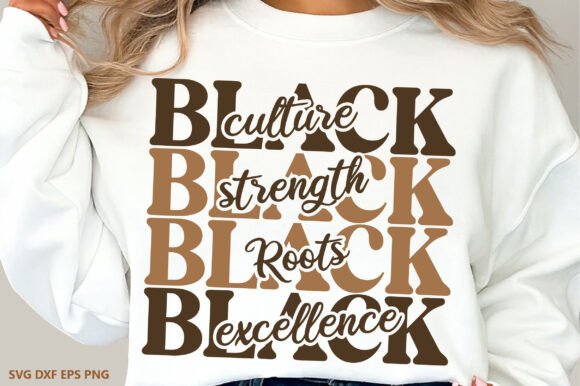
When I opened Black History Month PNG SVG EPS T-Shirt, my first thought wasn’t “Oh, another holiday graphic”—it was “This feels intentional.” The composition balances symbolism and simplicity: strong central lettering or a thoughtful emblem (depending on the variant), clean negative space, and deliberate line weight. It doesn’t shout—it resonates. As someone who regularly translates digital files into embroidered patches, baby onesies, and boutique aprons, I immediately saw its potential beyond the t-shirt label. This isn’t just a print-on-demand graphic—it’s a design that carries weight, and it shows in how the shapes hold up at different scales.
How It Performs on Real Embroidery Projects
I tested Black History Month PNG SVG EPS T-Shirt across three real-world scenarios: a 10”x12” embroidered tote bag for a local community center, a set of organic cotton baby onesies, and a limited-run patch collection for a small shop’s February launch. On the tote, the vector files scaled beautifully—I used the EPS version to resize cleanly for a 4.5” hoop without jagged edges or pixelation. The satin stitch areas (like outlined letters or borders) stitched smoothly with medium-density fill, and the open spaces between elements gave breath to the design—no dense thread buildup that could stiffen the canvas.
For the baby onesies, I opted for the SVG file in my embroidery software and simplified two small decorative flourishes manually—those tiny loops didn’t translate well below 2.8” wide, especially on lightweight knit. But the core message remained crisp: bold, legible, and warm. Customers noticed. One buyer wrote, “It felt handmade—not mass-produced—and the stitching looked like it belonged.” That’s the quiet win: Black History Month PNG SVG EPS T-Shirt supports authenticity when executed thoughtfully.
The patch run confirmed its versatility as a machine embroidery design. Using tear-away stabilizer and 40-weight rayon thread, the design held its shape through washing tests and iron-on backing application. No puckering. No skipped stitches—even on the curved edge of the patch border. That tells me the original vector paths were built with stitch logic in mind, not just visual appeal.
Where to Use It Thoughtfully (and Where to Pause)
This embroidery file shines on stable, medium-weight fabrics: canvas totes, cotton sweatshirts, linen tea towels, structured caps, and woven pillow covers. It holds up well on dark fabric—especially when paired with high-contrast thread (navy + gold, charcoal + cream). But I’d avoid it on ultra-stretchy performance knits without heavy cut-away stabilizer, and I’d skip it entirely for sub-2” hoops unless you’re willing to simplify by hand in your software.
Small details—like fine serifs or tight inner corners—need testing. On textured terrycloth kitchen towels, those same details blurred slightly, so I switched to running stitch outlines instead of satin for clarity. And while the PNG files are perfect for printable mockups or digital product previews, they’re not embroidery-ready: always start from the EPS, AI, or SVG vector files for stitch editing and scaling.
What It Adds to Your Handmade Product—and What It Asks of You
Black History Month PNG SVG EPS T-Shirt elevates perceived value because it looks considered—not generic. When stitched onto a linen apron for a Black-owned café, it communicated care and alignment, not just decoration. Customers engaged more: longer dwell time on the Etsy listing, higher add-to-carts, and repeat mentions in reviews about “meaningful branding.”
But that impact depends on execution. Thread color choice matters deeply here. A muted olive or deep plum reads with quiet dignity; neon yellow can unintentionally undercut the tone. Likewise, stitch density must stay balanced—overfilling the letterforms makes them rigid and less tactile. This is a handmade product asset, not a clipart drop-in. Its strength lies in how respectfully it’s brought to life.
Practical Notes Every Embroidery Designer Should Check
- Always test on scrap fabric first—especially if using it on baby items or layered garments where backing might show.
- Review stitch density in your embroidery software: look for overlapping fills or long jump stitches that could snag.
- Confirm hoop size compatibility before digitizing—some versions of this design may exceed standard 5”x7” limits when fully scaled.
- Inspect small details at 200% zoom in your vector editor—tiny gaps or stray anchor points cause stitching errors.
- Test black-and-white mockups to verify contrast on light and dark fabric backgrounds before finalizing thread colors.
- Use proper stabilizer: medium-weight cut-away for knits, tear-away for wovens, and fusible for lightweight linens.
- Verify licensing before selling finished items or reselling the digital embroidery file—this affects Etsy sellers and craft business owners directly.
Final Thought: A Design That Serves Purpose—and People
Black History Month PNG SVG EPS T-Shirt isn’t flashy—but it doesn’t need to be. It’s the kind of digital embroidery file that works quietly, consistently, and respectfully across custom apparel, personalized gifts, and small shop merchandise. Whether you’re stitching a single nursery pillow cover or producing 50 embroidered patches for a school event, it gives you room to focus on craft—not crisis-fixing poorly constructed vectors. That’s rare. And valuable. Keep it in your design assets folder—not as filler, but as a grounded, versatile tool for meaningful making.